
Compared with a spreadsheet
Group home software vs a spreadsheet with ambitions.
Most small operators run their houses on a spreadsheet, text threads and memory. None of it is dramatic. It just quietly costs money and sleep. Here is where it costs, and what to use instead.
By Joseph Surgeon, founder of Royalty Group Homes, who runs independent living homes in Oceanside.
Group home software is a system built around the bed: who is in it, what it earns, and what each resident owes. A spreadsheet is a grid that holds whatever you type into it. The difference shows up in five places.
This page is for an operator of one to about ten independent living, sober living or shared houses. In California, many such homes need no state license, so nothing outside the house sets how the records are kept. If you run a state-licensed care facility or a clinical one, read how operations software compares with a clinical EHR instead.
What does a bed that sits empty three weeks cost?
Today
The sheet has a row that says the bed is open. Nobody adds up what that costs, so it reads as a status, not as money. You notice at the end of the month, when the rent is short.
In Royalty Group Homes
The bed board shows every bed as earning, being turned, or empty. Each empty bed is priced at its monthly rate. A vacancy is a number on the first screen you open, not a word in a cell.
What happens when a payment is entered twice?
Today
One person types the payment when the resident hands it over. Another types it again from the bank deposit. The total looks fine until a resident disputes a balance. Then nobody can say which row is real, and fixing it means overwriting a cell.
In Royalty Group Homes
Every payment is an entry on that resident's month. A wrong one is fixed with a signed correction, and the original stays visible. A payment not yet confirmed sits apart from arrears. Generating a month twice never charges anyone twice.
Why does the vacancy list go stale?
Today
You emailed a list of open beds to a discharge planner. Half of them filled since. The next time, they call somebody else first, because your list burned them once.
In Royalty Group Homes
Confirm an open bed and it joins a date-stamped list. A bed not reconfirmed in two weeks comes off the public board by itself. Stale entries are flagged to you before a discharge planner finds them.
Who is in which bed after three transfers?
Today
There is a bed column next to each resident's name. Somebody has to update it on every move. After a few transfers the sheet and the house disagree.
In Royalty Group Homes
A resident's bed comes from their open stay, not from a field somebody types. Move-ins, bed changes and move-outs are kept as history. A transfer bills the move day to the new bed only.
Which referral partner stopped calling?
Today
Hospitals, case managers and social workers live in your phone and your memory. A partner goes quiet for two months and nobody notices.
In Royalty Group Homes
Referral partners are a list with the last contact on each one. Outreach is drafted for you. Nothing goes out until a named person approves the exact text.
What the month looks like in writing
A spreadsheet tells you what you typed. The operating brief tells you what it means: your figures in plain English, each number checked against your records first, with a numbered list of what to do about them.
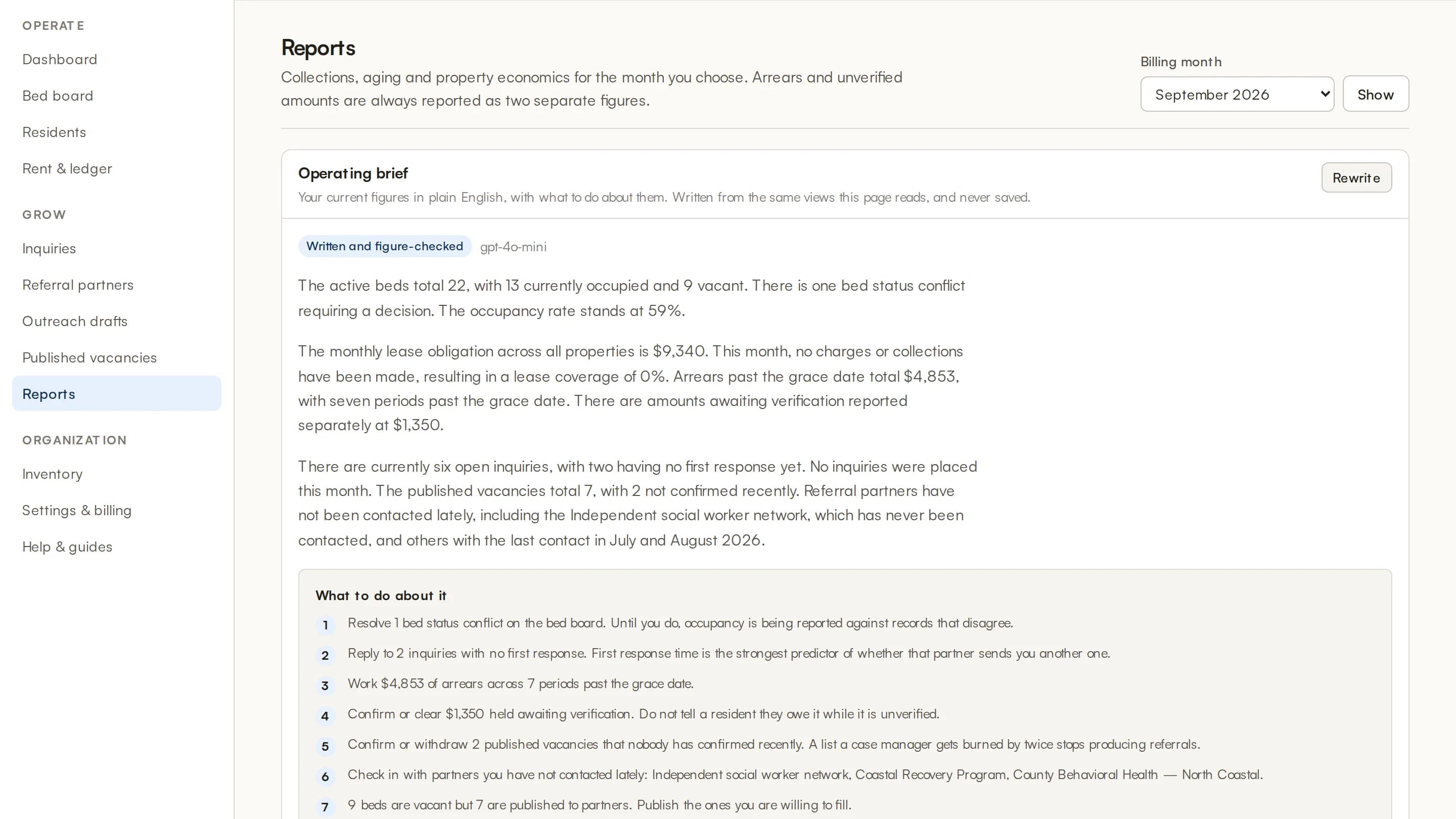
The real application, with example records.
How much does an empty bed cost, worked out?
Take a bed at $1,100 a month. That is about $36 a night. Three weeks empty is about $760 you will not see.
On a spreadsheet that money is invisible until rent comes in short. On the bed board the same bed shows as empty, priced at $1,100 a month. The reports add up every empty bed into one figure for the month.
For comparison, the plan for two or three houses is $99 a month. One bed filled a week sooner pays for it.
What about a resident who moves in mid-month?
A spreadsheet needs somebody to work out the partial month by hand. Each house usually does it a little differently.
Here, rent for part of a month is the monthly rate times the nights covered, divided by the days in that month. Both the move-in day and the move-out date count. A $900 bed with a move-in on October 20 covers 12 nights of 31. October is charged $348.39. A full month is always the full rate.
The rate is copied onto the stay at move-in. A later change to the bed's rate never rewrites what a resident already agreed to pay.
When is rent actually late?
On a sheet, "late" is whatever the person updating it decides. Two managers can give a family two different answers.
Here, a full month is due on the 1st. Each month has a grace window, 10 days unless you set another number. Money still owed inside the window shows as Due, not late. After the window it shows as Unpaid and counts in arrears.
Arrears are grouped by age: current, 1 to 30 days, 31 to 60, 61 to 90, and over 90. A payment somebody flagged as unclear is held out of arrears until it is verified.
When is a spreadsheet still fine?
A spreadsheet is free, you already know it, and it bends to anything. If you run one house and the sheet has never cost you a bed or a payment, keep it.
The trouble tends to start when a second person types into it. That is where the payment entered twice comes from. Research agrees: fifteen years of studies found spreadsheet errors common and non-trivial.
This is not an accounting system either. Your books stay in your accounting software. The ledger exports to CSV for your bookkeeper: entries, months and aging.
How do you move off the sheet?
There is no spreadsheet import yet. One house goes in over an afternoon: rooms, beds and current residents with their rent.
Several houses are loaded with you on a call. You should be running on real figures the same week you pay, not typing for a month first.
Keep the sheet open next to it for the first month. Close it when the bed board and the ledger agree with what you know about the house.
Related pages
Sources
- Spreadsheet Errors: What We Know. What We Think We Can Do, Raymond R. Panko, University of Hawaii. Fifteen years of studies found spreadsheet errors common and non-trivial.
- Group Home Technical Advisory (2022), page 33, California Department of Housing and Community Development. Many, if not most, group homes do not require a state license.
- Adult Facility Types Licensed by CDSS, California Department of Social Services. Which homes need a state care license, such as an adult residential facility.
One house is free with every feature, no card and no end date. Try it next to the spreadsheet for a month and see which one you open first.